
Everyone is inherently needy—it’s part of being human. Some needs are vital for our basic survival, like food, shelter, and touch, while others are essential for a healthy, fulfilled life. When our needs are not met… we struggle.
One of the most compassionate ways to navigate through challenging times is to ask yourself, “What do I need?” Start with basics like sleep, water, food, touch, or personal time. Then, explore more nuanced needs for connecting to yourself and loved ones.
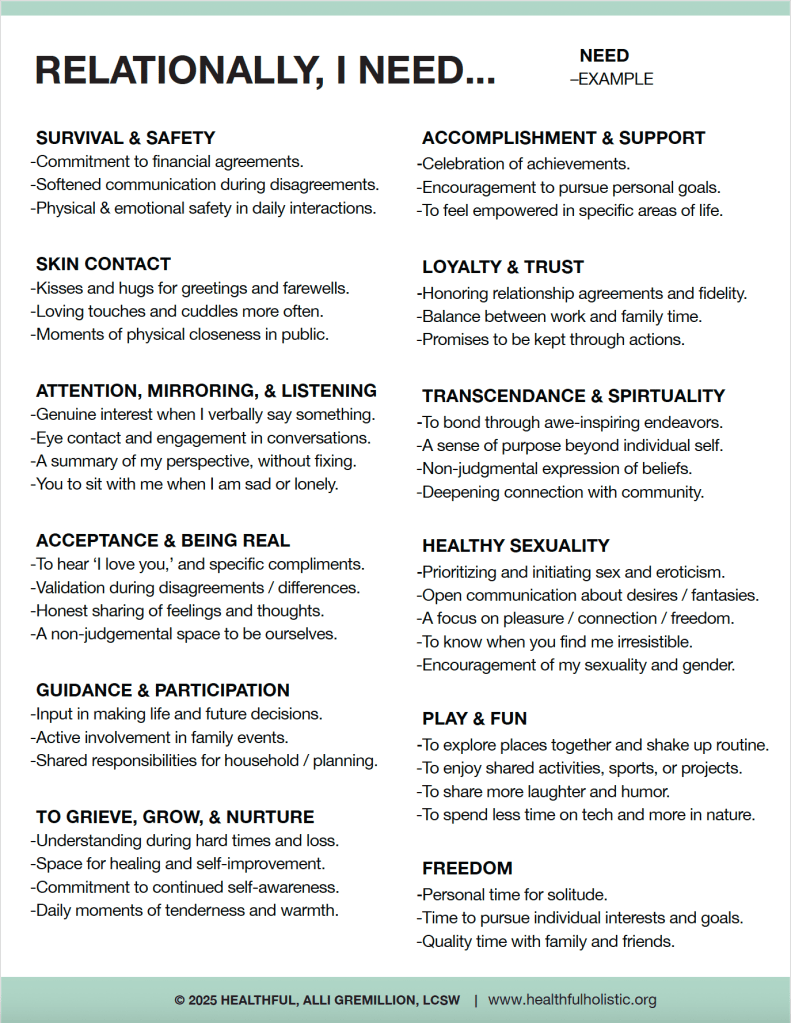
Here’s a 1-page PDF, inspired by the field of human development, designed to help you explore fundamental human needs, including examples of positive ways to express them within your relationships. Make it your own:
Keep in mind:
- Distinguish between needs (e.g., food) and wants (e.g., dining at a high-end restaurant). Wants can sometimes feel like needs, because they are often based from deeper longings. If a specific want is unattainable, consider addressing the core need or practice self-soothing in moments of unmet desires.
- Certain needs may feel more important during different seasons of life. This can be based on our unique circumstances, upbringings, unhealed wounds, values, and lifestyle. Periodically reassess what needs you may be malnourished in.
- As we age, we become our own primary caregivers, while loved ones take on a secondary, supporting role. This can be challenging for those who did not have needs adequately met in childhood. Learn to recognize, grieve, and seek support.
- Healthy meeting of relational needs involves multiple people, including yourself, family, friends, partners, and colleagues. Aim to build a supportive community.
- Our needs can be in conflict at times even within ourselves, such as the simultaneous emotional need for security and novelty. Each aspect deserves to be acknowledged and nurtured.
- Understanding and communicating needs is vital for maintaining healthy relationships. Don’t make other’s mind-read or assume. It’s okay to express a request, even if it cannot be met.
Resources that inspired PDF
(Book) In Charles L. Whitfield’s “Healing the Child Within,” he compiles a hierarchical list of 20 needs drawing from Maslow, Wheel, Miller, and Glasser. The needs, in order, include: 1) survival, 2) safety, 3) touching/skin contact, 4) attention, 5) mirroring/echo, 6) guidance, 7) listening, 8) being real, 9) participating, 10) acceptance (awareness, admiration, freedom to be yourself, including tolerance of your feelings, validation, respect, belonging, love), 11) opportunity to grieve losses and grow, 12) support, 13) loyalty/trust, 14) accomplishment (mastery, power, control, creativity, sense of completion, making a contribution), 15) alternating consciousness/transcending the ordinary, 16) sexuality, 17) enjoyment/fun, 18) freedom, 19) nurturing, 20) unconditional love/connection to a higher power.
(Online Course) “Feeling Seen and Heard” by The Gottman Institute provides a specific list of needs and requests designed to foster a deeper connection with your partner.
(Theory) Maslow’s hierarchy of needs, developed in 1938 and influenced by the teachings and philosophy of the Blackfeet tribe, offers an intriguing perspective on our individual and collective needs. While imperfect, the concept divides our needs into stages that we naturally cycle through based on age, culture, and life experiences.
(PDF) Non-violent communication is a valuable tool for understanding how your needs influence your emotions, especially when they are met or unmet. The goal is to express your positive needs without provoking defensiveness or blame in others.
Reflection
When looking at a list like this, connect with what feels right and leave behind what doesn’t. Tailor these requests to fit various relationships, ages, cultures, and backgrounds. Acknowledging our needs without resistance or guilt offers a pathway to soothing our inner worlds. I hope you discover the strength and solace that come from nurturing your needs. May you be needy. May you be healthful.
Ongoing series: Self-awareness, Emotions, Needs




 Healthful